

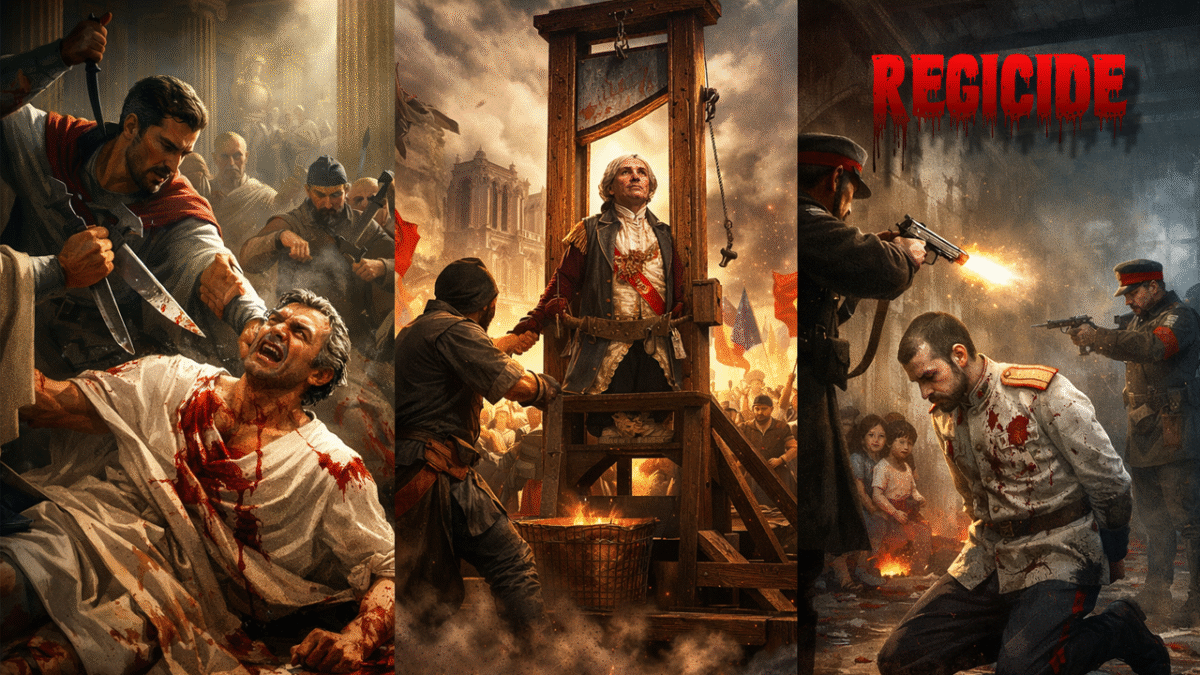
The term “regicide” describes the murder of a king or other ruler, usually with the goal of depriving them of their position of authority.
Historical Context
Regicide has taken place in many political and civilizational contexts throughout history. A number of factors, such as political turmoil, insurrection, succession issues, religious conflicts, and personal grudges, have led to the assassination of monarchs and other rulers.
Methods
Assassination, poisoning, execution, and staged accidents are just a few of the ways that regicide can be committed. The circumstances, incentives, and resources at the offenders’ disposal frequently influence the strategy selected.
Notable Examples
Regicide has occurred frequently throughout history, and some of these incidents have had a major impact on how cultures and nations have developed.
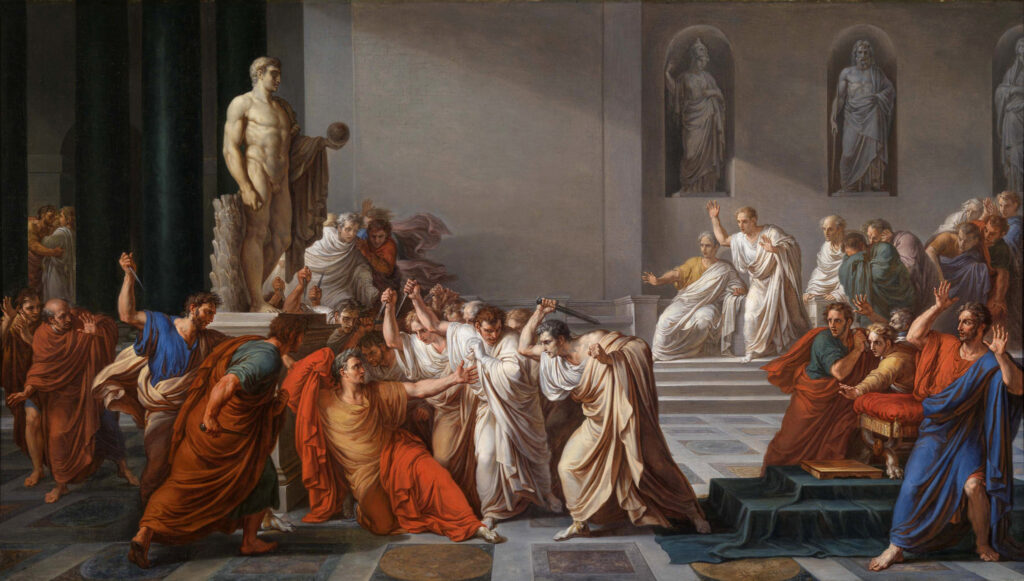
Julius Caesar
One of the most well-known cases of regicide in ancient history was the assassination of Julius Caesar in 44 BCE by a group of Roman senators led by Brutus and Cassius. Rome went through a period of political unrest and civil strife after Caesar’s death. (regicide)
https://designerchoicevja.blogspot.com
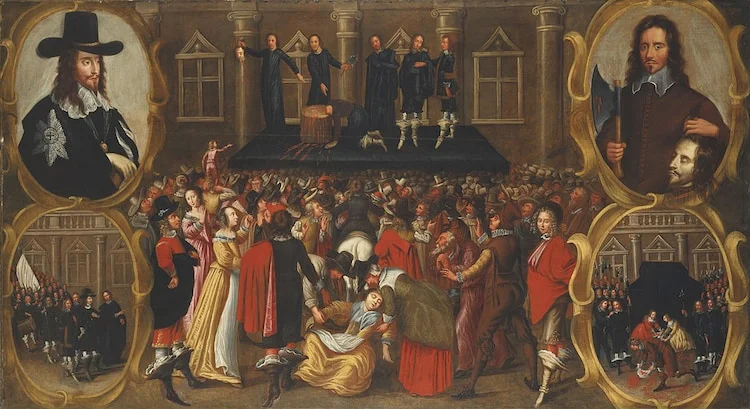
Charles I of England
Following his defeat by Oliver Cromwell’s parliamentary armies during the English Civil War, Charles I was beheaded in 1649. For a short while, known as the English Interregnum, his execution signaled the end of the monarchy in England. (regicide)
Louis XVI of France
After the French Republic was established and the monarchy was abolished in 1793, Louis XVI was put to death by guillotine during the French Revolution. His execution represented the fall of the previous government and the emergence of revolutionary principles. (Regicide)
Nicholas II of Russia
In 1918, during the Russian Revolution, Bolshevik rebels put Nicholas II, the country’s final Tsar, and his family to death. The Romanov dynasty came to an end with the execution, and Communist dictatorship in Russia began. (regicide)
Legal and Moral Repercussions
Regicide is frequently seen as a serious crime with grave moral and legal ramifications. It can result in instability, anarchy, and bloodshed and directly challenges the legitimacy and authority of the governing regime. Regicide carries harsh punishments, such as death or incarceration, in many countries.
All things considered, regicide is an important historical phenomena that has influenced political history and had profound effects on national stability and government. It continues to be a potent representation of revolution, resistance, and the fight for freedom and power. (Regicide)
Regicide – An Advanced View
1. The Political Theory of Regicide
The perception of regicide varies depending on one’s ideology:
A. Tyrannicide (Justifiable Murder)
According to some thinkers, if a ruler is a despot, it may be morally acceptable to kill them.
Locke, John
felt the people had the right to remove unfair leaders from power.
Aquinas, Thomas
discussed whether overthrowing a despot may be justified for the benefit of all. According to this perspective, regicide is an act of emancipation.
B. Kings’ Divine Right (Unjustifiable Crime)
James VI and me
ardent advocate of the notion that God selects kings.
According to this theory, regicide is equal to treason plus sin.
2. The Regicide of Revolution
A. occurs during revolutions.
Symbolic and public
For instance, Louis XVI of France
B.Regicide via Conspiracy
Insiders or elites with covert schemes
For instance, Julius Caesar
C. The Regicide of Dynasties
For power inside royal families
For instance, In a similar power battle, Aurangzeb imprisoned his father, Shah Jahan, rather than killing him.
d. Regicide based on ideology
Motivated by political philosophies (nationalism, communism)
Nicholas II of Russia, for instance
3. Additional Worldwide Examples
The Ancient World
Macedon’s Philip II
Alexander the Great’s father
The Middle Ages
England’s Edward II
After being ousted, possibly slain.
Early Modern Era
Sweden’s Gustav III
Famous dramatic regicide, shot at a masked ball.
The Modern Era
As monarchs fall, political assassinations persist but true regicide becomes less common.
4. Regicide Causes (Deep Analysis)
a. Power Abuse
High taxes, Oppression, Decline in popular confidence
During the French Revolution
B. Unpredictability in politics
Inadequate leadership
Observed during the English Civil War
C. Shift in Ideology
Growth of nationalism, socialism, and democracy
During the Russian Revolution
D. Struggles for Elite Power
Leaders in the military or nobles vying for power
Observed in Roman plots
5. Regicide’s Aftereffects
a. Direct Impacts
Civil war or chaos, Using a power vacuum, Murders committed in retaliation
b. Long-Term Consequences
1. Emergence of Novel Systems
Republics, Democracies, Communist nations
For instance, under Louis XVI of France, the Republic
2. Monarchy’s Strengthening
Regicide can occasionally backfire and result in more powerful rulers.
3. Symbolic Significance
Regicide conveys a strong message
“No ruler is untouchable.”
6. Regicide in Literature and Culture
A common motif in stories is regicide
Macbeth
A king is killed in order to gain power, which results in shame and demise.
The Game of Thrones
Brutal power battles are demonstrated by the deaths of several kings.
7. Contemporary Significance
Despite the fact that there are fewer kings now
Political assassinations have evolved from regicide.
Presidents and prime ministers are among the leaders who confront comparable dangers.
For instance, John F. Kennedy (similar influence but not a king)
8. Crucial Realization
Killing a ruler is only one aspect of regicide;
other aspects include…….
Power’s legitimacy
The freedom of individuals to rebel
Political system transition
It frequently signifies the end of one era and the start of a new one.